

In the Name of Allah, the Most Gracious, the Most Merciful
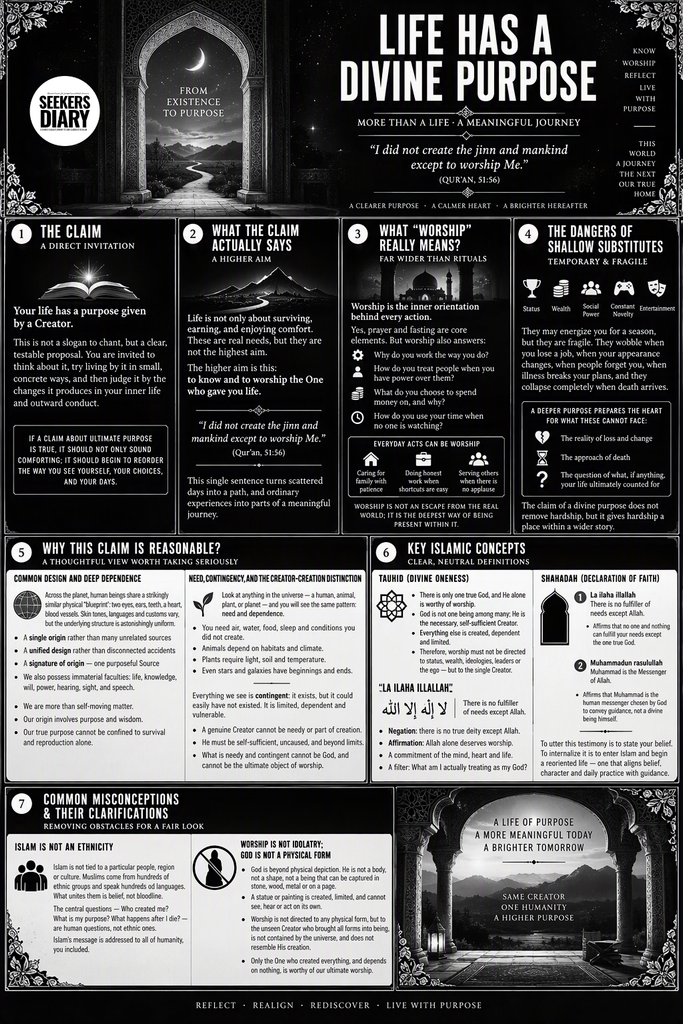
The claim offered to you is direct: your life has a purpose given by a Creator. This is not a slogan to chant or a line to accept because it sounds noble. It is a clear, testable proposal. You are invited to think about it, to try living by it in small, concrete ways, and then to judge it by the changes; if any; that it produces in your inner life and outward conduct.
This is the standard we will use again and again: If a claim about ultimate purpose is true, it should not only sound comforting; it should begin to reorder the way you see yourself, your choices, and your days.
WHAT THE CLAIM ACTUALLY SAYS
The claim denies that life is only about surviving, earning, and enjoying comfort. These are real needs, but they are not the highest aim. The higher aim is this: to know and to worship the One who gave you life.
The Qur’an states this with striking simplicity:
“I did not create the jinn and mankind except to worship Me.”
Qur’an, 51:56
That single sentence does more than explain; it directs. It turns scattered days into a path, and ordinary experiences; work, family, struggle, rest; into parts of a meaningful journey oriented toward the One who created you intentionally, not accidentally.

WHAT “WORSHIP” REALLY MEANS?
For many, the word worship sounds narrow; images of rituals, special buildings, and religious professionals. But in this view, worship is far wider and far more intimate than that.
Yes, formal acts such as prayer and fasting are core elements of worship. But they are not the whole story. Worship, in its full sense, is the inner orientation behind every action. It answers questions such as:
- Why do you work the way you do?
- How do you treat people when you have power over them?
- What do you choose to spend money on, and why?
- How do you use your time when no one is watching?
When an action; small or large; is done with the conscious awareness that you are seeking the pleasure of your Creator, that action becomes worship. This view reshapes daily life:
- Caring for family with patience
- Doing honest work when shortcuts are easy
- Serving others when there is no applause
All of these, when done for the sake of the One who sees you completely, become part of the spiritual life. In this way, worship is not an escape from the “real world”; it is the deepest way of being present within it.
WARNING ABOUT SHALLOW SUBSTITUTES
You already know many of the alternative “purposes” that are offered to you: Status, Wealth, Social Power, Constant Novelty and Entertainment.
They may energize you for a season, but they all share one feature: they are fragile. They depend on circumstances you cannot fully control. They wobble when you lose a job, when your appearance changes, when people forget you, when illness breaks your plans, and they collapse completely when death steps into the room.
A deeper purpose prepares the heart for what these transient measures cannot face:
- The reality of loss and change
- The approach of death
- The question of what, if anything, your life ultimately counted for
The claim of a divine purpose does not remove hardship, but it gives hardship a place within a wider story. It offers inner steadiness when external success fluctuates, and moral clarity when the surrounding culture keeps shifting its standards.

WHY THIS CLAIM IS REASONABLE?
The idea that life has a divine purpose deserves to be taken seriously; it’s a view a thoughtful person can reasonably hold. Here are two simple points that support it.
Common Design and Deep Dependence
Across the planet, human beings share a strikingly similar physical “blueprint”: two eyes set in a face, ears on either side of the head, teeth arranged in a patterned jaw, a heart beating in the chest, blood vessels branching like rivers. Skin tones, languages, and customs vary, but the underlying structure is astonishingly uniform.
For a reflective mind, this common pattern is not trivial. It naturally suggests:
- A single origin rather than many unrelated sources
- A unified design rather than disconnected accidents
This striking common blueprint across races and regions acts like a signature of origin. It suggests not a crowd of competing creators, each making their own version of a human, but one Originator who designed the human form and life‑system with coherence and intent.
Different ethnicities do not change the underlying human nature. The most natural reading of this shared structure is that we come from one purposeful Source, not from many disconnected ones.
But our design is not only physical. We also possess immaterial faculties that we all recognize, though we cannot touch or weigh them:
- Life
- Knowledge
- Will
- Power
- Hearing
- Sight
- Speech, as lived experiences, not just mechanical reactions
You can trace the biology of the eye, the pathways of the brain, the chemistry of the bloodstream. Yet the experience of seeing, choosing, knowing, loving; these are not captured by molecules and electrical signals alone. They are hosted in the body, but they are not reducible to flesh and bone.
The fact that such formless faculties are consistently housed in a fragile material vessel hints strongly that:
- We are more than self‑moving matter.
- Our origin involves purpose and wisdom that exceed the blind play of particles.
- Our true purpose cannot be confined to survival and reproduction alone.
These reflections do not force belief, but they make the idea of a purposeful Creator; and a human purpose that rises above mere biology; highly reasonable.
Need, Contingency, and the Difference Between Creator & Creation
Look carefully at anything in the universe; a human, an animal, a plant, a planet; and you will see the same pattern: need and dependence.
- You need air, water, food, sleep, protection, and countless conditions you did not create.
- Animals depend on habitats, climates, cycles of day and night.
- Plants require light, soil, and temperature ranges.
- Even stars and galaxies have beginnings, transformations, and ends.
Everything we can point to is contingent: it exists, but it could easily have not existed. It came into being; it changes; it passes away. It is limited, dependent, and vulnerable.
If there is a true God, then by definition God cannot be like this. A genuine Creator:
- Cannot be needy, because then He would depend on something else.
- Cannot be merely one more finite object in the universe, because then He would be part of the created order, not its source.
- Must be self‑sufficient, uncaused, and not bound by the limits that mark everything we see.
From this, a simple conclusion follows:
What is needy, finite, and contingent cannot be God. And if it cannot be God, then it cannot reasonably be taken as the ultimate object of worship.
This includes:
- Human beings, no matter how powerful or inspiring
- Forces of nature, no matter how vast
- Wealth, pleasure, status, or any created thing our hearts cling to
They are all receivers, not givers, of existence. To treat them as the ultimate source of meaning is to lean your full weight on what is, at root, fragile.
Recognizing this difference between Creator and creation is not a closed-minded belief; it is a rational protection against false worship; against building your life around what will one day fail you.
Taken together, the unity of our design and the radical neediness of everything around us do not “prove” the claim in a mathematical sense. But they form a strong, reasonable foundation for it:
- That there is one purposeful Creator behind our existence
- And that our true purpose must be sought in relation to Him, not in the passing arrangements of this temporary world.

KEY ISLAMIC CONCEPTS EXPLAINED : CLEAR, NEUTRAL DEFINITIONS
In order to test the claim that life has a divine purpose in an Islamic framework, a few key terms need to be clear. These concepts are not slogans; they are precise ideas that shape how a believer understands God, self, and purpose. What follows are neutral, straightforward definitions, explained in a way that a seeker or skeptic can follow and evaluate.
Tauhid (Divine Oneness)
Tauhid is the recognition and affirmation that there is only one true God, and that this one God alone is worthy of worship. It is the central axis of Islamic belief.
Tauhid answers two questions at once:
- Who is the ultimate source of everything?
- Who alone deserves my final loyalty, trust, and devotion?
In this view:
- God is not one being among many; He is the necessary, self‑sufficient Creator of all that exists.
- Everything else; people, powers, forces, objects; is created, dependent, and limited.
Because of this, worship (in the full sense of love, fear, trust, obedience, and ultimate hope) must not be directed to created things, no matter how impressive or useful they are. Tauhid therefore explains why a life of purpose, in the Islamic understanding, requires turning away from worship of:
- Status and wealth
- Ideologies and leaders
- Even one’s own ego and desires
and turning instead, with exclusivity, to the single, self‑sufficient Creator.
LIFE IS NOT ONLY ABOUT SURVIVING, EARNING, AND ENJOYING COMFORT. THESE ARE REAL NEEDS, BUT THEY ARE NOT THE HIGHEST AIM. THE HIGHER AIM IS THIS: TO KNOW AND TO WORSHIP THE ONE WHO GAVE YOU LIFE.




“LA ILAHA ILLALLAH”
“There is no fulfiller of needs except Allah”
The phrase “La ilaha illallah” literally means: “There is no fulfiller of needs except Allah.”
In simple terms, it carries two linked ideas:
- Negation: there is no true deity in all existence except the one real God.
- Affirmation: that one real God ∙ Allah ∙ is the only One who deserves worship.
This statement is both intellectual and practical. It is not meant as a bare sound on the tongue or a cultural label. To accept it seriously means:
- With the mind: recognizing that no created thing has the qualities of the true God; no one else is self‑sufficient, all‑knowing, all‑powerful, and free from need.
- With the heart: withdrawing deep, ultimate attachment from anything less than God; no longer treating career, relationships, status, or any person as the ultimate center of meaning.
- With the life: allowing this conviction to shape choices, priorities, and allegiances.
In that sense, “La ilaha illallah” is a filter. It asks you:
What am I actually treating as my God; the thing I fear to lose most, the thing I obey without question, the thing I hope will finally complete me?
The phrase calls you to redirect that central place back to the Creator alone.
SHAHADAH (DECLARATION OF FAITH)
The Shahadah is the formal declaration of faith in Islam. It has two connected parts:
- “La ilaha illallah” ∙ There is no fulfiller of needs except Allah.
- This affirms that no one and nothing can fulfill your needs except the one true God.
- “Muhammadun rasulullah” ∙ Muhammad is the Messenger of Allah.
- This affirms that Muhammad is the human messenger chosen by God to convey guidance, not a divine being himself.
To utter this testimony is to publicly state that:
- You accept the oneness of God and refuse to treat any created thing as a rival god.
- You accept that Muhammad faithfully delivered God’s message, and that his example and teachings are a trustworthy guide to living a life of submission and purpose.
To internalize this testimony is something deeper. It marks:
- Entry into Islam in the formal sense.
- The beginning of a reoriented life; one that seeks to align belief, character, and daily practice with what God has revealed.
From the perspective of this chapter, the Shahadah is not a magic formula. It is a conscious commitment: to let the recognition of one true God, and the guidance brought by His messenger, reshape how you understand yourself, your purpose, and your future.

COMMON MISCONCEPTIONS & THEIR CLARIFICATIONS
When the claim “life has a divine purpose” is presented in an Islamic framework, certain ideas and images often stand in the way. It helps to set these aside gently; not to win a debate, but to remove needless obstacles so you can look at the main claim fairly. The following short clarifications are offered in that spirit.
Islam Is Not an Ethnicity
A widespread misconception is that Islam belongs to a particular people, region, or “type” of person; often imagined as Arab, Middle Eastern, or tied to a specific culture. This is inaccurate and, if left unchallenged, can quietly block serious engagement.
In reality, Islam is universal in its claim and its following. Muslims come from hundreds of ethnic groups and speak hundreds of languages. You will find them in Africa, Asia, Europe, the Americas, and beyond, with very different cuisines, dress styles, and customs. What unites them is not bloodline but belief: the recognition of one God and the acceptance of His guidance.
Why does this matter for a seeker or skeptic? Because if you think of Islam as “their religion” (some distant group) rather than a message addressed to you as a human being, you may dismiss it without fully hearing what it says. The central questions; Who created me? What is my purpose? What happens after I die? – are human questions, not ethnic ones. The Islamic claim is that its answers are addressed to all of humanity, you included.
Worship Is Not Idolatry; God Is Not a Physical Form
Another common confusion arises from the word worship. For some, it brings to mind carved statues, paintings of divine figures, or holy objects that people bow to and kiss. Islam explicitly rejects this kind of image‑based worship.
Islam stresses that God is beyond physical depiction. He is not a body, not a shape, not a being that can be captured in stone, wood, metal, or on a page. Because of this, creating or selling images that claim to represent God is strongly criticized; not only as inaccurate, but as an attempt to commodify what is utterly beyond our tools and techniques.
From this perspective:
- A statue or painting is something made by human hands.
- It is located in a place, limited in size, subject to damage and decay.
- It cannot see, hear, or act on its own.
Such an object is, in every sense, created and needy. To kneel before it as if it were the source of existence is, in Islamic terms, a serious confusion of categories.
In Islam, worship is not directed to any physical form; no human figure, no animal, no abstract symbol. It is directed to the unseen Creator who:
- Brought all forms into being,
- Is not contained by the universe,
- And does not resemble His creation.
The issue is not art versus no art; it is who or what is being treated as divine. Islam protects the distinction sharply: only the One who created everything, and depends on nothing, is worthy of our ultimate worship.