

In the Name of Allah, the Most Gracious, the Most Merciful
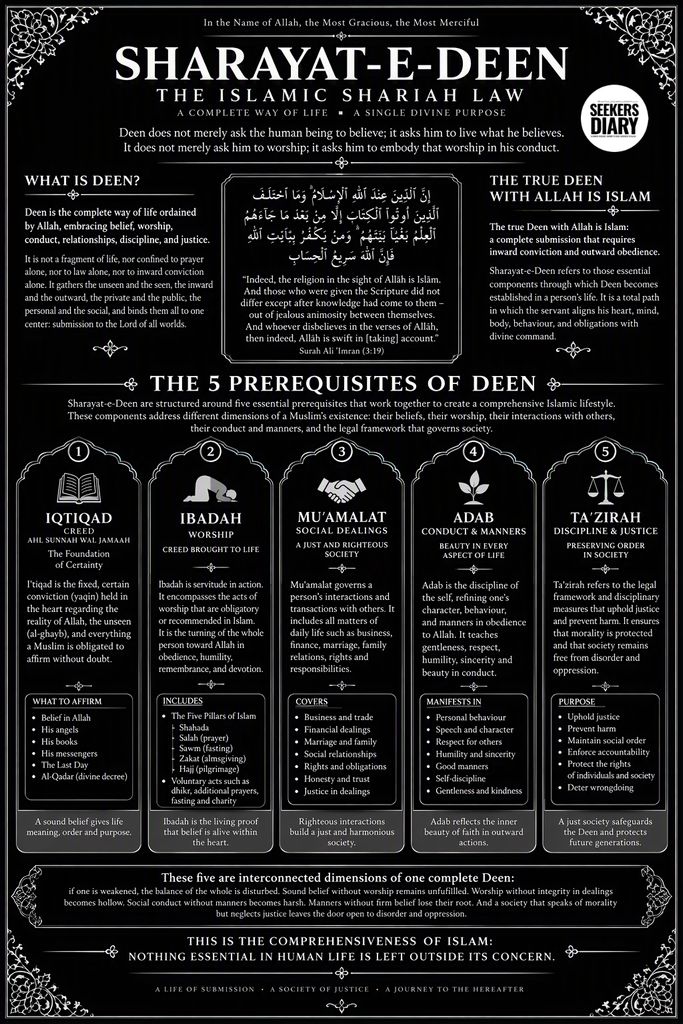
Deen is not a fragment of life. It is not confined to prayer alone, nor to law alone, nor to inward conviction alone. It is the complete ordering of the human being under the command of Allah. It gathers the unseen and the seen, the inward and the outward, the private and the public, the personal and the social, and binds them all to one center: submission to the Lord of all worlds.
Deen is the complete way of life ordained by Allah, embracing belief, worship, conduct, relationships, discipline, and justice. It governs the inner state of a person as well as his outward life, and it brings order to both the individual and society.
In this understanding, Deen is not merely a matter of personal spirituality, nor only a legal structure, nor simply moral teaching. Rather, it is a total path in which the servant aligns his heart, mind, body, behavior, and obligations with divine command. This is why the path of Deen begins with what a person believes, then extends into how he worships, how he deals with others, how he conducts himself, and how justice is preserved in the wider social order.
إِنَّ ٱلدِّينَ عِندَ ٱللَّهِ ٱلْإِسْلَـٰمُ ۗ وَمَا ٱخْتَلَفَ ٱلَّذِينَ أُوتُوا۟ ٱلْكِتَـٰبَ إِلَّا مِنۢ بَعْدِ مَا جَآءَهُمُ ٱلْعِلْمُ بَغْيًۢا بَيْنَهُمْ ۗ وَمَن يَكْفُرْ بِـَٔايَـٰتِ ٱللَّهِ فَإِنَّ ٱللَّهَ سَرِيعُ ٱلْحِسَابِ
“Indeed, the religion in the sight of Allāh is Islām. And those who were given the Scripture did not differ except after knowledge had come to them – out of jealous animosity between themselves. And whoever disbelieves in the verses of Allāh, then indeed, Allāh is swift in [taking] account.”
Surah Ali ’Imran (3:19)
The true Deen with Allah is Islam: a complete submission that requires inward conviction and outward obedience. Thus, Sharayat-e-Deen refers to those essential components through which Deen becomes established in a person’s life.

The 5 PREREQUISITES OF DEEN
Sharayat-e-Deen are structured around five essential prerequisites that work together to create a comprehensive Islamic lifestyle. These components address different dimensions of a Muslim’s existence: their beliefs, their worship, their interactions with others, their conduct and manners, and the legal framework that governs society.
They are interconnected dimensions of one complete Deen: if one is weakened, the balance of the whole is disturbed. Sound belief without worship remains unfulfilled. Worship without integrity in dealings becomes hollow. Social conduct without manners becomes harsh. Manners without firm belief lose their root. And a society that speaks of morality but neglects justice leaves the door open to disorder and oppression.
DEEN DOES NOT MERELY ASK THE HUMAN BEING TO BELIEVE; IT ASKS HIM TO LIVE WHAT HE BELIEVES. IT DOES NOT MERELY ASK HIM TO WORSHIP; IT ASKS HIM TO EMBODY THAT WORSHIP IN HIS CONDUCT.
It does not merely teach him gentleness and beauty of manner; it also teaches him seriousness, restraint, and accountability.
This is the comprehensiveness of Islam: nothing essential in human life is left outside its concern. For this reason, there are five prerequisites of Deen; Iʿtiqad, Ibadah, Muʿamalat, Adab, and Taʿzirah.
IQTIQAD ∙ CREED ∙ AHL SUNNAH WAL JAMAAH ∙ THE FOUNDATION OF CERTAINTY
Everything begins with Iʿtiqad, for nothing can be sound if the heart is unsound in what it knows and affirms about Allah. Iʿtiqad is the fixed, certain conviction (yaqin) held in the heart regarding the reality of Allah, the unseen (al-ghayb), and everything a Muslim is obligated to affirm without doubt. It is not a passing opinion or intellectual preference.
To possess sound Iʿtiqad is to affirm what every Muslim must affirm without hesitation: belief in Allah, in His angels, in His books, in His messengers, in the Last Day, and in al-Qadar, the divine decree in both what pleases and what pains. It is to know that Allah is One, without partner; that Muhammad ﷺ is His final Messenger; that revelation is true; that resurrection is true; that judgment is true; and that nothing escapes the knowledge, will, and wisdom of the Lord of the worlds.
A strong foundation in belief is crucial as it shapes a Muslim’s worldview and underpins all other aspects of their religious practice. It provides the spiritual and intellectual grounding necessary for a meaningful relationship with Allah.
If belief is sound, life begins to take on order. The world is no longer a scattered field of desires and accidents, but a place of meaning, trust, test, and accountability. Worship then becomes intelligible, obedience becomes purposeful, and restraint becomes possible. A person with sound belief does not merely perform religion; he sees existence itself through the light of religion.
If belief is corrupted, then even outward forms may remain empty of their true spirit. A person may appear religious, and yet the inner axis of his life may be unstable. This is why Iqtiqad comes first. It is the root of the tree. If the root is healthy, the branches may flourish, the leaves may grow, and the fruit may ripen. If the root decays, no outward greenness can endure for long. Failing to diligently study and grasp the principles of Aqidah (Islamic Creed) invariably places an individual in a state of continuous sinfulness. This is not a minor deviation but a pervasive condition that impacts one’s spiritual standing.
This creed is not left to private improvisation. It has been preserved in the transmitted path of Ahl al-Sunnah wa’l-Jamaʿah, carried through the generations by scholars who guarded the meanings of revelation from distortion, denial, and excess.
Ahl Sunnah Al-Jama’ah (People of the Sunnah & the Community) has meticulously safeguarded the true understanding of Allah and His divine law (Deen) for over fourteen centuries. This sacred knowledge is transmitted through an unbroken Silsilah (chain of spiritual and scholarly lineage) that traces directly back to the noble Messenger, Prophet Muhammad (peace be upon him). This ensures the integrity and authenticity of our understanding.
IBADAH ∙ WORSHIP ∙ CREED BROUGHT TO LIFE
From belief emerges Ibadah; encompassing the acts of worship that are obligatory or recommended in Islam. This includes the five pillars of Islam: Shahada (declaration of faith), Salah (prayer), Sawm (fasting), Zakat (almsgiving), and Hajj (pilgrimage).
Ibadah refers to all acts of worship that are performed to seek the pleasure of Allah. This includes the five pillars of Islam, as well as voluntary acts of worship such as prayer, fasting, charity, and remembrance of Allah (Dhikr).
The significance of Ibadah is that it keeps the connection between the servant and Allah alive and active; for what the heart truly knows, the body must come to express. Faith that does not bend the knee, humble the self, discipline the appetite, and turn the servant toward his Lord remains incomplete in its manifestation. Ibadah is therefore the living proof that belief is alive within the heart.
Ibadah is servitude in action. It is the turning of the whole person toward Allah in obedience, humility, remembrance, and devotion. Through it, the servant acknowledges that he is not his own master. He belongs to Allah, stands in need of Allah, and finds his dignity not in independence from his Lord, but in submission to Him.
Yet Ibadah is not mere motion, nor ritual emptied of spirit. Its purpose is to awaken the heart, purify intention, discipline the self, and train the soul in consistency before Allah. Through worship, the human being is repeatedly drawn away from heedlessness and returned to remembrance. The restless self is ordered. The scattered heart is recollected. The arrogance of ego is softened by humility. Desire is restrained, time is sanctified, and life is measured not by impulse, but by obedience.
Belief alone, if not nourished by worship, can become weak, abstract, or neglected. Ibadah strengthens conviction, purifies intention, and reorders the soul. It reminds the believer that he is not autonomous, but a servant. It also protects him from becoming absorbed solely in worldly concerns.
Ibadah is therefore not limited to private spirituality. It is a formative discipline. It cultivates obedience and prepares the believer to live righteously in all other domains. The one who worships Allah properly is trained in submission, and this submission must then become visible in conduct, dealings, and moral responsibility.
MUAMALAT ∙ TRANSACTION LAW ∙ DEEN IN THE WORLD OF HUMAN AFFAIRS
Islam does not end at the prayer mat or the fasting day. As the body of Deen, it extends into the ordinary dealings of life, including business, commerce, contracts, finance, and social transactions. This sphere is known as Mu‘amalat; it governs how people deal with one another in the material and social world.
If Ibadah governs the servant’s relation with his Lord, Muamalat governs his relation with the creation of his Lord. Here Deen leaves the privacy of the prayer space and enters the marketplace, the home, the street, the court, the gathering, the exchange, and every domain in which one human being meets another. It is here that faith is tested in its social truthfulness.
Muamalat refers to the ethical and moral conduct in interactions and transactions with others. It includes principles of honesty, justice, fairness, and integrity in business and social dealings. Muamalat refers to interactions and transactions between people, including business dealings, contracts, and social relationships. Understanding and practicing ethical and fair dealings is crucial for maintaining justice and harmony in society. It reflects the application of Islamic principles in everyday interactions.
It addresses the practical web of human interaction through which societies either stand in justice or collapse into corruption. A person may speak beautifully of faith, and yet if he deceives, betrays, exploits, and oppresses in his dealings, then the moral force of that faith is called into question.
This is because Deen does not accept a split life. It does not permit a person to be devout before Allah and dishonest before people, nor humble in worship and arrogant in transaction. The same Lord Who commands prayer also commands justice. The same revelation that purifies belief also regulates dealings. Thus Muamalat makes clear that religion does not end where social life begins; rather, religion enters social life and seeks to purify it.
The Prophet (ﷺ) said, “When you are three persons sitting together, then no two of you should hold secret counsel excluding the third person until you are with some other people too, for that would grieve him.”
In Muamalat, the believer learns that every interaction carries weight. Wealth is no longer merely a possession, but a trust. Speech is no longer merely expression, but responsibility. Agreements are no longer conveniences, but moral bonds. Human beings are no longer instruments of personal gain, but bearers of rights before Allah. Through this, Deen transforms society from a field of competing egos into a moral order structured by accountability and conscience. It protects society from moral collapse and ensures that faith is embodied in justice and integrity. Correct dealings are not an optional enhancement to religion; they are part of religion itself. Through Muamalat, the believer learns that every interaction carries moral weight and that accountability before Allah includes how one treats other human beings.
Fiqh Mu’amalat (Human Dealings/Transactions)
Worldly dealings are not outside religion. The marketplace is also a place of obedience. The exchange of wealth, the making of agreements, and the conduct of trade all fall within the moral order of Islam. A Muslim is not expected to be religious only in ritual and then morally unregulated in his transactions. Rather, the same submission that governs prayer must also govern earning, buying, selling, and dealing with others. This is an important feature of Islam as the body of Deen. It brings divine guidance into the visible structures of human society. It teaches that faith is not compartmentalized. The hand that gives charity, signs contracts, and manages property must also submit to Allah. Through Mu‘amalat, Islam shapes honesty, responsibility, fairness, and lawful conduct in everyday interaction.
This deals with our interactions with each other in daily life. It includes business, careers, jobs, financial transactions, buying and selling, contracts, and even everyday matters like shopping. It also delves into what is permissible (Halal) and impermissible (Haram) in these dealings. Islamic jurisprudence provides guidelines to ensure that these transactions are conducted fairly and justly, prohibiting practices like usury (Riba) and fraud. Understanding Muamalat is vital for Muslims to engage in ethical business practices and maintain social justice.
In the financial sphere, this means that earning and exchange must be governed by honesty, clarity, and justice. Ribā is forbidden because it institutionalizes exploitation. Fraud is forbidden because it destroys trust. Gharar and deception are forbidden because human need must not become an opportunity for manipulation. Lawful provision is itself a spiritual matter. What one consumes enters not only the body, but the soul’s condition. A life nourished by the unlawful darkens worship from within.
فَبِمَا رَحْمَةٍۢ مِّنَ ٱللَّهِ لِنتَ لَهُمْ ۖ وَلَوْ كُنتَ فَظًّا غَلِيظَ ٱلْقَلْبِ لَٱنفَضُّوا۟ مِنْ حَوْلِكَ ۖ فَٱعْفُ عَنْهُمْ وَٱسْتَغْفِرْ لَهُمْ وَشَاوِرْهُمْ فِى ٱلْأَمْرِ ۖ فَإِذَا عَزَمْتَ فَتَوَكَّلْ عَلَى ٱللَّهِ ۚ إِنَّ ٱللَّهَ يُحِبُّ ٱلْمُتَوَكِّلِينَ
“It is out of Allah’s mercy that you ˹O Prophet˺ have been lenient with them. Had you been cruel or hard-hearted, they would have certainly abandoned you. So pardon them, ask Allah’s forgiveness for them, and consult with them in ˹conducting˺ matters. Once you make a decision, put your trust in Allah. Surely Allah loves those who trust in Him.”
Surah Ali ‘Imran (3:159)
Fiqh Munakahat (Laws of Marriage)
In the domestic sphere, among the most important outward domains of Islam is marriage and family law, referred to as Munakahat. This includes marriage, divorce, inheritance, and the wider ordering of family relationships.
This branch covers all aspects related to marriage, family law, divorce, inheritance, and the rights and responsibilities within marital relationships. This aspect of Fiqh addresses the laws and ethics surrounding marriage and family life. It includes the rights and responsibilities of spouses, the process of marriage and divorce, and issues related to inheritance and child custody. Understanding Munakahat helps Muslims build strong, harmonious family units that align with Islamic values.
The family is one of the primary places in which Deen is either preserved or weakened. For that reason, Islam does not leave family life to instinct, custom, or personal preference alone. It provides laws, boundaries, and responsibilities through which family life can be protected and dignified.
Marriage is not treated as a merely private arrangement, nor is lineage regarded as socially insignificant. Through family law, Islam preserves honor, continuity, responsibility, and social stability. It recognizes that the integrity of the household shapes the integrity of society.
This is why the family belongs fully within the body of Deen. The same divine guidance that governs worship also governs kinship, inheritance, and the bonds between generations. This section of Shariah is especially important because it connects directly to the preservation of dignity and lineage, one of the higher objectives of Islamic law.
A person may be regular in prayer and yet corrupt in transactions, tender in private devotion and yet unjust in the treatment of spouse, partner, employee, or neighbor. Such a person has preserved one dimension of Deen while wounding another. Muʿāmalāt exists to prevent precisely this fracture. It insists that surrender to Allah must appear not only in prostration, but in contracts, earnings, family life, and public trust.
ADAB ∙ MANNERISMS / CODE OF CONDUCT ∙ THE BEAUTY OF ISLAM
If Muʿamalat makes conduct just, Adab makes it beautiful. Adab is the refinement of conduct, manners, etiquette, and moral character. It concerns the way a person carries himself before Allah, before the Prophet, before knowledge, before people, and even before his own self. Adab gives beauty to Deen. It is the grace, discipline, and moral polish of a life shaped by faith.
It is possible for a transaction to be valid and still be harsh. It is possible for a marriage to be legally intact and still be devoid of grace. It is possible for speech to be technically true and still be cruel. Adab is what protects religion from becoming cold correctness. It is the refinement of the soul until lawful action becomes beautiful action.
Adab includes one’s behaviour before Allah: reverence, modesty, gratitude, and humility. It includes one’s conduct with the Messenger ﷺ through love for his Sunnah and honor for his legacy. It includes one’s bearing toward teachers, parents, elders, children, guests, neighbors, and even one’s own self. It extends to the etiquette of speech, eating, listening, disagreement, greeting, entering homes, keeping company, showing mercy to animals, and walking gently upon the earth.
Adab is seen in speech that is measured, in presence that is gentle, in strength that is restrained, in knowledge that is humble, and in devotion that does not harden into pride. It is the quiet order that protects the human being from coarseness, vanity, rudeness, and self-importance. It teaches one to know the right place of things: the rights of elders, the dignity of others, the sanctity of knowledge, the demands of companionship, the etiquette of disagreement, the discipline of the tongue, and the modesty proper to one who stands always before Allah.
A person may possess learning and yet lack Adab. He may perform worship and yet wound others with harshness. He may observe lawful boundaries and yet be rough, arrogant, and spiritually unrefined. Such a person has grasped part of Deen while losing something of its fragrance. For Adab is not ornament detached from substance; it is the sign that the substance has penetrated the character.
Within the larger structure of Deen, Adab is what preserves harmony between the inner and outer person. It ensures that worship does not become self-righteousness, knowledge does not become pride, and social engagement does not become roughness. It forms the believer into someone whose conduct reflects mercy, dignity, and balance.
Much of Adab cannot be enforced by law, yet without it a community becomes spiritually coarse. Law can forbid backbiting in the sense of warning against its sin, but Adab teaches the tongue restraint, tenderness, and wisdom. Law can define the rights of parents, but Adab teaches the softness in the voice, the lowered wing of mercy. Law can structure gatherings, but Adab fills them with dignity, receptivity, and barakah.
A believer with Adab carries religion in a way that invites hearts rather than repels them. He understands that truth must not only be held firmly, but borne with reverence and balance. Thus Adab perfects what the previous components establish. If Iqtiqad gives root, Ibadah gives devotion, and Muamalat gives justice, then Adab gives nobility. It guards religion from becoming dry, harsh, mechanical, or self-righteous. It is the polish of the soul and the beauty of obedient living.
For this reason, Adab is often learned not only from texts, but from company. One sees it embodied in the bearing of the righteous: in how they sit, how they listen, how they answer, how they disagree, how they guard the honor of others, how they remember Allah without performance. A teacher may explain manners, but often his truest lesson is the manner in which he lives them. Adab passes from soul to soul through presence as much as through instruction.
It is no surprise, then, that the Messenger of Allah ﷺ was described as having magnificent character, and that perfection of character was named among the very purposes of his mission. Adab is not an ornament added after religion is complete. It is one of the signs that religion has actually penetrated the self.
TA’ZIRAH ∙ PENAL LAW ∙ FIQH JINAYAT
Ta’zirah, also referred to as Jinayat, refers to the legal and penal aspects of Islamic law; the domain of criminal law; this includes crimes, punishments, and penal matters. Its inclusion reminds us that Islam is not only a system of personal devotion, but a comprehensive framework for moral and social order. A religion that commands prayer and charity, but remains silent about public wrongdoing and justice, would be incomplete as a way of life. Islam, by contrast, extends its concern into the protection of society itself. It is a complete legal and moral framework that addresses social wrongdoing and protects society from corruption and harm.
The presence of criminal law within Shariah shows that the body of Deen includes boundaries, consequences, and accountability. Human life in society requires protection from corruption, harm, and transgression. Jinayat is therefore part of Islam’s outward structure of justice. It safeguards society by placing boundaries around what is forbidden and by upholding accountability.
The inclusion of Ta’zirah among the components of Deen shows that Islam is not only concerned with personal piety and good intention, but also with accountability and the protection of communal well-being. A society cannot endure on ideals alone if it lacks mechanisms to deter wrongdoing and uphold rights.
At the same time, Ta’zirah must be understood with seriousness and care. It is not a domain of personal vengeance, emotional reaction, or careless severity. It belongs to the sphere of justice, authority, evidence, and responsibility. Its purpose is not cruelty, but the preservation of order, prevention of harm, and safeguarding of society. It stands within the moral vision of Deen, where justice must always be tied to fairness, restraint, and due process.
In this sense, Ta’zirah completes the outward structure of Deen. Where Iqtiqad rectifies belief, Ibadah rectifies devotion, Muamalat rectifies dealings, and Adab rectifies character, Ta’zirah rectifies disorder at the societal level. It represents the legal seriousness of Deen and its commitment to upholding justice in communal life.
إِنَّ ٱلدِّينَ عِندَ ٱللَّهِ ٱلْإِسْلَـٰمُ ۗ وَمَا ٱخْتَلَفَ ٱلَّذِينَ أُوتُوا۟ ٱلْكِتَـٰبَ إِلَّا مِنۢ بَعْدِ مَا جَآءَهُمُ ٱلْعِلْمُ بَغْيًۢا بَيْنَهُمْ ۗ وَمَن يَكْفُرْ بِـَٔايَـٰتِ ٱللَّهِ فَإِنَّ ٱللَّهَ سَرِيعُ ٱلْحِسَابِ
“Indeed, the religion in the sight of Allāh is Islām. And those who were given the Scripture did not differ except after knowledge had come to them – out of jealous animosity between themselves. And whoever disbelieves in the verses of Allāh, then indeed, Allāh is swift in [taking] account.”
Surah Ali ‘Imran (3:19)




CONCLUSION
Sharayat-e-Deen is the complete framework by which Deen is established in human life. These five components must be understood as a unified whole. They are one path seen through five necessary dimensions. Each supports the others, and each is diminished when cut off from the rest.
- Iʿtiqad is the root
- gives the correct inner foundation ∙ the conviction from which everything else draws life.
- Ibadah is the stem rising directly from that root
- gives disciplined obedience to Allah ∙ devotion to Allah made manifest.
- Muʿamalat is the outward branching
- gives justice and honesty in human dealings ∙ justice extended to other people through binding dealings.
- Adab is the fruit’s sweetness
- gives beauty, humility, and refinement of conduct ∙ the beauty of character that makes lawful action also good action.
- Taʿzirah is the fence around the whole tree
- gives protection to social order and public justice ∙ the boundary that protects root, stem, branch, and fruit from being trampled.
Remove any one, and the structure fails at a specific point: without Iʿtiqad, worship is misdirected; without Ibadah, belief is inert; without Muʿamalat, society becomes unjust; without Adab, justice becomes cold and graceless; without Taʿzirah, the entire structure is left undefended against transgression.
When these are present together, Deen becomes balanced and complete. The believer is not merely a thinker, nor only a worshipper, nor simply a moralist, nor only a law-abiding subject. He becomes a servant of Allah whose belief is sound, whose worship is sincere, whose dealings are just, whose manners are noble, and whose understanding of justice is rooted in divine guidance.