
In the Name of Allah, the Most Gracious, the Most Merciful
INDEBTEDNESS: WHO ARE WE INDEBTED TO?
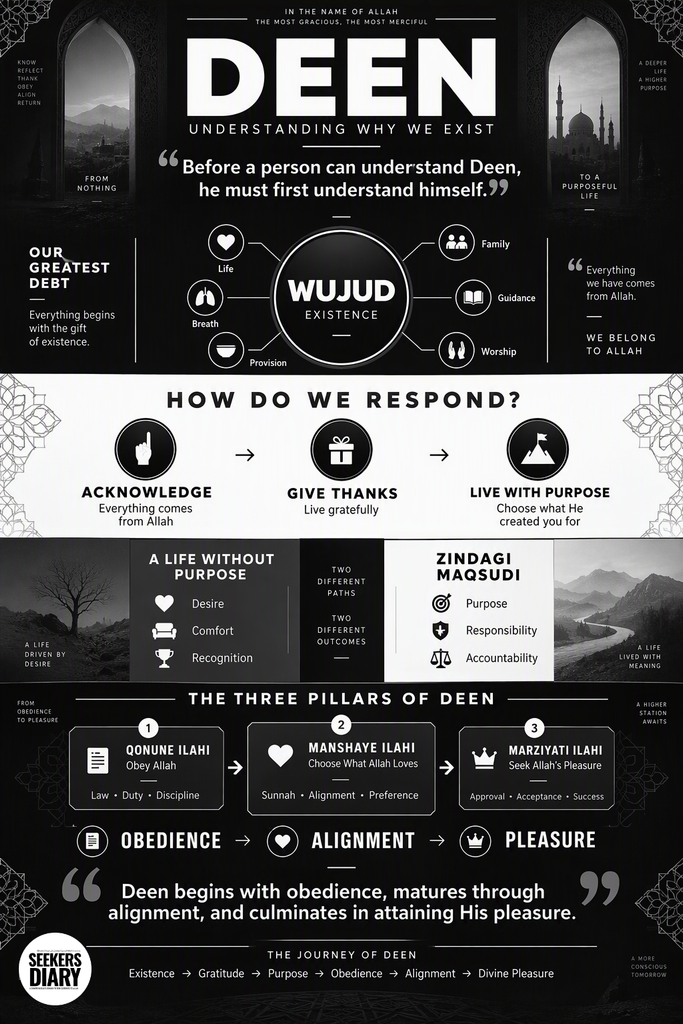
Before a person can understand Deen, he must first understand himself.
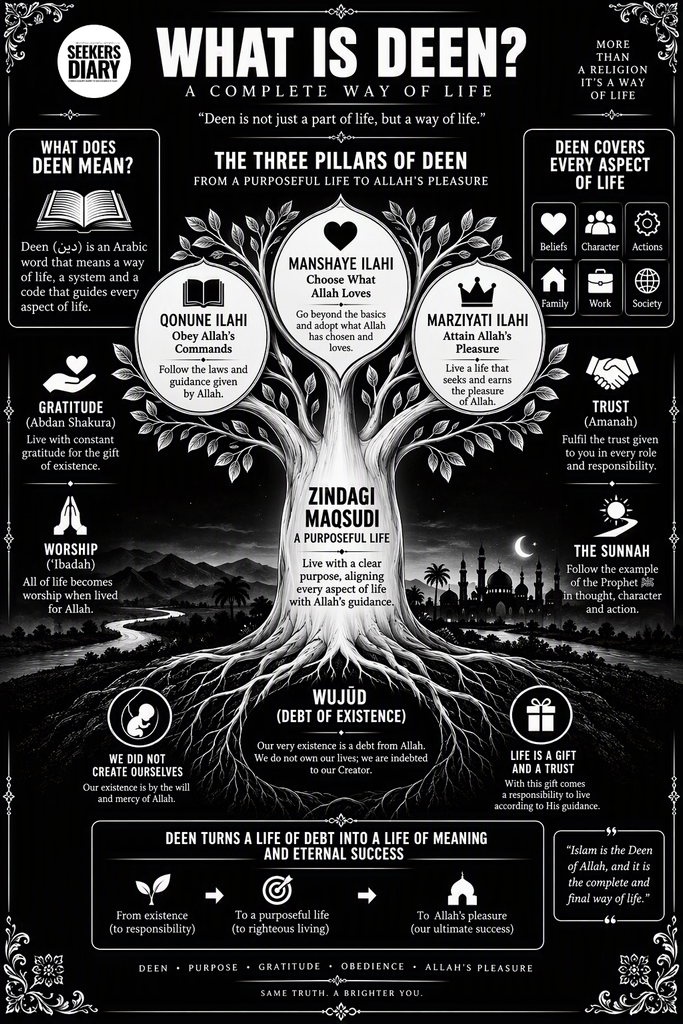
We owe the greatest debt of all; the debt of wujud; the debt of existence; to Allah. He is the One who brought us into existence when we were nothing. Had He not willed our creation, we would not have known life, breath, thought, feeling, provision, family, guidance, or the opportunity to worship. Existence itself is His gift.
This is the first and most fundamental reality of the human condition: we are indebted to the One who gave us being. Our debt to Allah is unlike any other debt. It is not the debt of a favor that can be returned in equal measure. It is not the debt of a temporary kindness, nor the repayment of a single blessing among many. It is a total debt, because our entire existence is from Him. Everything we possess; our bodies, our faculties, our time, our opportunities, our sustenance, our guidance; comes from Allah.
Without existence, nothing else would have been possible. We would not be experiencing life as we know it. We would have no chance to love, choose, strive, worship, repent, or return. That is why the debt of wujud stands above every other debt.
A person who truly understands this can no longer view life as his own possession. He begins to see that he has not created himself, does not sustain himself, and cannot independently direct the purpose of his life. He belongs to Allah.
To understand Deen correctly, one must begin with this awareness of indebtedness. A person who recognizes that his very being is from Allah will begin to see that life cannot be lived carelessly, aimlessly, or independently of divine guidance. Life itself becomes a trust (amanah), and existence becomes a responsibility.
INDEBTEDNESS: HOW DO WE PAY BACK?
This debt can never be fully repaid in an absolute sense, because no one can truly repay the One who gave him existence. However, the believer responds to this debt in the only way possible: by acknowledging it, by giving thanks, and by living in a manner pleasing to Allah.
We pay back by recognizing the source of all blessings. We pay back by recognizing that everything we have comes from Him. We pay back by showing gratitude for His blessings. We pay back by refusing to live thoughtlessly, selfishly, aimlessly with a self-directed life based solely on personal desire, and instead choosing to live according to the purpose for which He created us.
This is Zindagi Maqsudi; a purposeful life.
A purposeful life is not one driven merely by appetite, comfort, career, social recognition, or worldly success. It is a life consciously lived in light of divine purpose. It is the life of one who knows that existence is not random, and that the human being was not created without meaning. Such a person understands that every day, every choice, and every breath carries responsibility before Allah.
To repay this debt properly, one must also strive to become an Abdan Shakura; a grateful servant. Gratitude in Deen is not limited to words. It is a condition of the heart, a recognition of divine favor, and a way of life expressed through obedience, humility, remembrance, service, and submission. True gratitude is shown not only by saying that Allah has blessed us, but by living in a way that reflects appreciation for those blessings.

THREE RUKUN (PILLARS) OF DEEN
These three pillars help explain how a servant moves from basic submission to deeper alignment, and from alignment to the highest station of all: the pleasure of Allah.
- Qonune Ilahi ∙ to obey commands of Allah & all that is wajib
- Manshaye Ilahi ∙ to take on the will/preferences of Allah, manifested in the Sunnah of the Prophet ﷺ
- Marziyati Ilahi ∙ to be satisfied and pleased with Allah & seeking pleasure & approval of Allah
Together, they provide a framework for understanding the life of Deen. They show that Islam is not merely about doing the minimum that is required, nor only about personal spirituality detached from law and discipline. Rather, Deen begins with obedience, matures through choosing what Allah prefers, and culminates in attaining His pleasure.
The servant first learns to submit to Allah’s commands. Then he trains his heart to prefer Allah’s will over his own. Finally, through sustained obedience and sincere alignment, he hopes to reach the station where Allah is pleased with him.
QONUNE ILAHI ∙ Adherence to Divine Commands
Qonune Ilahi refers to the law, command, and injunction of Allah. This refers to all that Allah has made obligatory upon His servants. It is the domain of wajibat: the divine commands that must be fulfilled, the lawful and unlawful boundaries that must be respected, and the foundational duties that form the structure of a Muslim life. This includes acts of worship such as salah, fasting, zakat, and hajj, along with the wider demands of halal and haram, ethics, responsibility, and obedience.
Qonune Ilahi teaches the servant that his life is not his own to legislate. He does not decide right and wrong based merely on personal preference, convenience, mood, social expectation, or cultural pressure. He submits to what Allah has commanded because Allah is his Lord.
It demands steadfastness. A believer may feel tired. He may be under strain. He may be distracted by worldly responsibilities. He may find obedience difficult in moments of inconvenience, fatigue, or inner resistance. But Qonune Ilahi requires that the command of Allah remain above all of that. The effort to comply is itself part of worship.
In this way, Qonune Ilahi forms the base of religious life. Without it, Deen loses its discipline, structure, and seriousness. A person cannot claim closeness to Allah while neglecting what Allah has clearly commanded. The divine law is the starting point of servitude.
It is also the mark of a responsible tenant of existence. Since our life is a trust from Allah, we must live under His authority. To obey His commands is to acknowledge that we are not independent beings, but servants living within a divinely ordered reality.
MANSHAYE ILAHI ∙ Choosing the Preferences of Allah
If Qonune Ilahi teaches the servant to obey what Allah has commanded, then Manshaye Ilahi teaches him to love what Allah loves.
Manshaye Ilahi calls the believer to move beyond the bare minimum. It is the conscious act of preferring Allah’s will over one’s own desires, inclinations, comforts, and social pressures. It is to ask not only, “What must I do?” but also, “What does Allah love from me?”
This category is expressed most clearly through the Sunnah of the Prophet Muhammad ﷺ. The Sunnah is not merely a collection of recommended actions in an external sense. It is the living manifestation of what is beloved to Allah. Through the life, conduct, habits, and teachings of the Messenger of Allah ﷺ, the believer is shown what it looks like to live according to divine preference.
Manshaye Ilahi involves letting go of self-prioritization. It means not making one’s own comfort, mood, or opinion the center of life. It means willingly aligning intentions, habits, and choices with divine preference. In this sense, it is a deeper form of surrender; where one’s own desires no longer become the measure of action. Nor do popular opinion, cultural fashion, or personal convenience. The believer instead seeks to align his inner and outer life with what Allah loves.
The world often defines work only as material effort that produces visible results. But in Deen, the highest work is service to Allah. Spiritual striving, obedience, sacrifice, remembrance, worship, and self-discipline are among the greatest forms of labor, even when no immediate worldly reward can be seen. Allah is the One who provides sustenance; our truest work is to serve Him.
MARZIYATI ILAHI ∙ The Pleasure of Allah
The highest goal of the believer is Marziyati Ilahi; the pleasure, approval, and satisfaction of Allah.
This is the ultimate aspiration of the believer. A person does not obey Allah merely to say he has fulfilled an obligation. Nor does he follow the Sunnah merely to adorn his life with extra virtue. The final aim is greater than both: that Allah becomes pleased with him. When the servant fulfills the commands of Allah and prefers what Allah loves, he walks the path that leads to divine pleasure. This is the true success of life.
Marziyati Ilahi means that Allah is pleased with His servant. It is the most precious success, because all worship, struggle, sacrifice, and obedience are ultimately directed toward this end. The believer does not seek only to be lawful, nor only to be disciplined, nor only to be outwardly righteous. He seeks to become acceptable and beloved in the sight of Allah.
The path to this pleasure is tied directly to obedience and prophetic following. If one truly loves Allah, then one must follow the Messenger ﷺ, and through that following Allah will love that person and forgive his sins. This shows that divine pleasure is not attained through claim alone, but through alignment with Allah’s commands and the Sunnah of His Prophet ﷺ.
When Allah is pleased with a servant, that servant has attained the true success of Deen.




WE OWE THE GREATEST DEBT OF ALL; THE DEBT OF WUJUD; THE DEBT OF EXISTENCE; TO ALLAH. HE IS THE ONE WHO BROUGHT US INTO EXISTENCE WHEN WE WERE NOTHING. HAD HE NOT WILLED OUR CREATION, WE WOULD NOT HAVE KNOWN LIFE, BREATH, THOUGHT, FEELING, PROVISION, FAMILY, GUIDANCE, OR THE OPPORTUNITY TO WORSHIP. EXISTENCE ITSELF IS HIS GIFT.

CONCLUSION
These three categories are not separate compartments. They form a spiritual progression.
Qonune Ilahi establishes obedience. Manshaye Ilahi refines obedience into love, preference, and conscious alignment. Marziyati Ilahi is the fruit of both; Allah’s pleasure with His servant.
The one who neglects Qonune Ilahi has no foundation. The one who stops only at bare obligation has not yet entered the fullness of what Deen calls him toward. And the one who seeks Marziyati Ilahi without first submitting to command and preference seeks an end without walking its path.
Together, these three components provide a complete architecture for the life of faith. They show that Deen is not merely legal, nor merely emotional, nor merely spiritual in an abstract sense. It is disciplined obedience, willing surrender, and the pursuit of divine pleasure; all held together in one integrated life.