
In the Name of Allah, the Most Gracious, the Most Merciful
- Purpose of Life: Why Do I Exist?: Preface
- How to Worship & Know Allah: The Journey of Experiential Knowledge
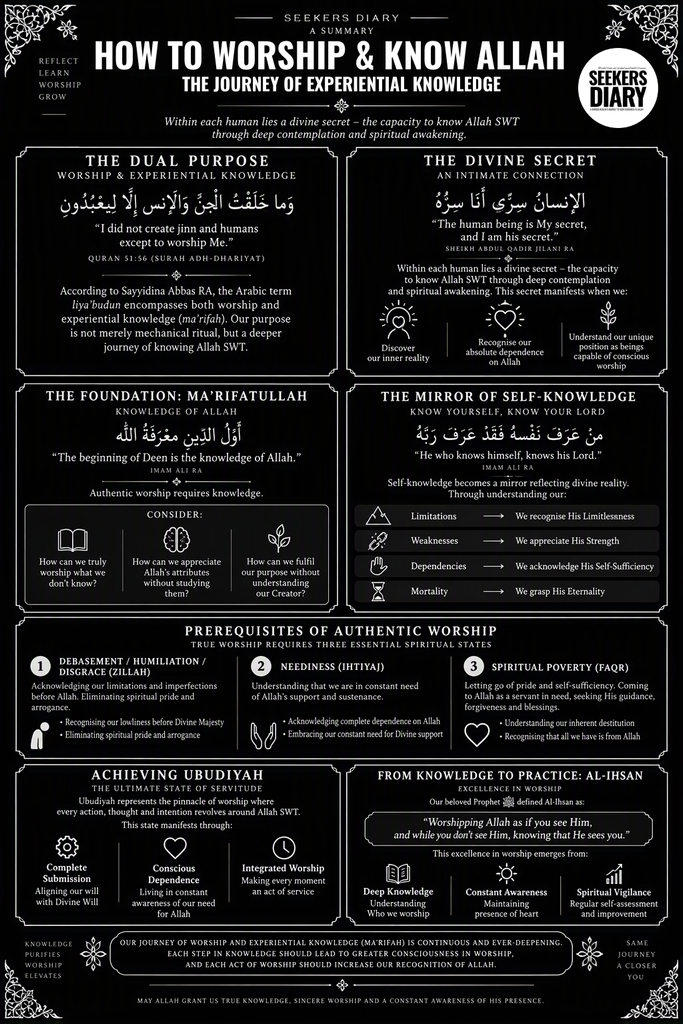
THE JOURNEY OF EXPERIENTIAL KNOWLEDGE
In our preface, we explored the fundamental question of why we exist. Now, we delve deeper into how we fulfil this divine purpose through worship and recognition of Allah.
Within each human lies a divine secret; the capacity to know Allah through deep contemplation and spiritual awakening.
More > Purpose of Life : Why Do I Exist? : Preface
THE DUAL PURPOSE
WORSHIP & EXPERIENTIAL KNOWLEDGE
وَمَا خَلَقْتُ ٱلْجِنَّ وَٱلْإِنسَ إِلَّا لِيَعْبُدُونِ
“I did not create jinn and humans except to worship Me.”
Quran 51:56 (Surah Adh-Dhariyat)
This verse carries layers of meaning beyond its apparent translation. As highlighted by Sayyidina Abbas r.a, the Arabic term لِيَعْبُدُونِ (liya’budun) encompasses both worship and experiential knowledge (ma’rifah). This dual meaning reveals that our purpose isn’t merely mechanical ritual, but a deeper journey of knowing Allah.
UNDERSTANDING TRUE WORSHIP THROUGH DIVINE SECRETS
الإنسانُ سِرِّي أنا سِرُّهُ
“The human being is My secret, and I am his secret”
Sheikh Abdul Qadir Jilani RA
This reveals an intimate connection between Creator and created. Within each human lies a divine secret; the capacity to know Allah through deep contemplation and spiritual awakening.
This secret manifests when we:
- Discover our inner reality
- Recognise our absolute dependence on Allah
- Understand our unique position as beings capable of conscious worship
The human person is a hidden interior whose deepest reality is known only to Allah, and Allah in turn has secretly endowed that interior with the capacity to recognise and be known. The phrase points to an intimate reciprocity between Creator and creature: the secret of the human heart is a chamber in which the Divine Secret may be unveiled, and the Divine Secret dwells within the human in a way that invites discovery.
THE HUMAN AS SECRET ∙ AL‑INSĀN SIRRI
The person possesses an inner domain; heart (kalb), soul (ruh), sirr (the inner secret), intellect and will; that is not exhausted by outward appearance or social roles. This inner realm contains motives, longings, veils, and potentials that are hidden even from the self unless it turns inward.
To “discover oneself” therefore is not mere psychology or biography; it is to penetrate the layers of nafs, unveil pretence and confront the realities of neediness, humility and dependence that make true servitude (ubudiyyah) possible. Knowing one’s poverty (faqar, muhtaj) before Allah is the first key to genuine spiritual life.
GOD AS SECRET ∙ WA ANA SIRRUHU
Allah’s presence and treasure are not abstract doctrines but an active, veiled intimacy. Allah’s secretness means He can be known only by grace and inner unveiling; yet He chooses to hide Himself within the very heart He created.
This hiddenness of Allah is a mercy: the soul can meet the Divine Secret; Ma‘rifah; because Allah has given humans an inner place where He can be recognized.
Knowing the self and knowing the Lord are inseparable. “He who knows himself knows his Lord.” Self‑discovery here is the spiritual method: by uncovering the heart’s conditions (need, humility, longing, sincerity) the seeker prepares the faculty that receives Divine light and witness. The inner work is not narcissism but purification that makes the heart a mirror for Divine realities.
Ma‘rifah is not merely intellectual; it is experiential witnessing (haqqul‑yāqīn). The phrase indicates that the Divine Secret is not outside us but intimately tied to our deepest secret; through sincere inward revelation and the removal of veils, the heart comes to witness Allah’s presence.
THE MIRROR OF SELF-KNOWLEDGE
مَن عَرَفَ نَفْسَهُ فَقَدْ عَرَفَ رَبَّهُ
Man ‘arafa nafsahu faqad ‘arafa Rabbahu
Imam Ali r.a
“He who knows himself, knows his Lord”
Self-knowledge becomes a mirror reflecting divine reality. Understanding our human nature; our limits, needs, and dependence; naturally leads us to recognise the Creator’s attributes: His power, mercy, wisdom, and care.
The inner journey of knowing the self (maʿrifat al‑nafs) leads straight to knowing Allah. Looking inward is not self‑absorption; it is a spiritual practice that reveals our created state, our needs, and our position before the Creator. By seeing ourselves honestly, we learn to see God more clearly.
The nafs (self) can hide Divine truth or reflect it. If left uncontrolled, it covers the heart with desire, show, and forgetfulness. But if we examine, discipline, and purify it, the nafs can become a polished surface that reflects Divine attributes.
Through understanding our:
- Limitations → We recognise His Limitlessness
- Weaknesses → We appreciate His Strength
- Dependencies → We acknowledge His Self-Sufficiency
- Mortality → We grasp His Eternality
As we discover our dependence on life’s every provision, the mind and heart are drawn into gratitude, humility and reliance; responses that disclose Allah’s reality and presence in a living way. The way to Allah goes through the self: by honestly facing and training our inner life; our poverty, needs, and tendencies; the heart is cleared to recognise the Creator. Self‑knowledge thus becomes the doorway to true knowledge of Allah.
PREREQUISITES OF AUTHENTIC WORSHIP
MAFHUM-E-IBADAT
Ibadate Haqq, Shanakhate Haqq
“Worship Allah, to know Him”
Ibadate Haqq means to worship Allah truly and rightly. Shanakhate Haqq means to know the Truth (Allah) so that worship becomes genuine, not just outward form. Together they assert: true worship is rooted in knowing Allah and showing that knowledge in every action; even in small acts like drinking a cup of tea. This requires an inner posture of destitution and the spiritual pre‑requisites of worship: Zillah (humility), Ihtihaj (neediness), and Faqr (poverty).
هَلۡ أَتَىٰ عَلَى ٱلۡإِنسَٰنِ حِينٌ مِّنَ ٱلدَّهۡرِ لَمۡ يَكُن شَيۡـًٔا مَّذۡكُورًا
Hal ata ʿala al-insani ḥinun mina al-dahri lam yakun shayʾan madzkura
Surah Al-Insan 76:1
“Has there [not] come upon man a period of time when he was not a thing [even] mentioned?”
True worship requires three essential spiritual states:
DEBASEMENT ∙ HUMILIATION ∙ DISGRACE ∙ ZILLAH
وَلَا تَمْشِ فِي الْأَرْضِ مَرَحًا ۖ إِنَّكَ لَن تَخْرِقَ الْأَرْضَ وَلَن تَبْلُغَ الْجِبَالَ طُولًا
“And do not walk upon the earth arrogantly.
Surah Al-Isra’ 17:37
Indeed, you will never tear the earth [apart], nor will you ever reach the mountains in height.”
Humility in worship involves acknowledging our limitations and imperfections before Allah. It is the recognition that, despite our efforts and achievements, we are ultimately dependent on Allah’s mercy and guidance. This humility is expressed through a sincere and humble attitude in prayer and other acts of worship, where we lower ourselves in submission to Allah’s greatness.
- Recognizing our lowliness before Divine Majesty
- Eliminating spiritual pride and arrogance
NEEDINESS ∙ IHTIYAJ
إِيَّاكَ نَعْبُدُ وَإِيَّاكَ نَسْتَعِينُ
“You alone we worship, and You alone we ask for help.”
Surah Al-Fatihah 1:5
Recognizing our neediness means understanding that we are in constant need of Allah’s support and sustenance. It is the realization that everything we have, including our existence, is dependent on Allah’s will. This sense of neediness fosters a deep reliance on Allah, encouraging us to turn to Him in all circumstances, whether in times of ease or difficulty.
- Acknowledging complete dependence on Allah
- Embracing our constant need for Divine support
SPIRITUAL POVERTY ∙ FAQR
وَٱللَّهُ ٱلۡغَنِيُّ وَأَنتُمُ ٱلۡفُقَرَآءُ
“Allāh is the Free of need, while you are the needy.”
Surah Muhammad 47:38
Approaching Allah with humility involves letting go of pride and self-sufficiency. It means coming to Allah as a servant in need, seeking His guidance, forgiveness, and blessings. This humble approach is reflected in our prayers, where we express our dependence on Allah and acknowledge His supreme authority.
- Understanding our inherent destitution
- Recognising that all we have is from Allah
ACHIEVING UBUDIYYAH
THE ULTIMATE STATE OF SERVITUDE
وَمَنْ أَعْرَضَ عَن ذِكْرِي فَإِنَّ لَهُۥ مَعِيشَةًۭ ضَنكًۭا وَنَحْشُرُهُۥ يَوْمَ ٱلْقِيَـٰمَةِ أَعْمَىٰ
Wa man aʿraḍa ʿan dhikrī fa-inna lahu maʿīshatan ḍankan, wa naḥshuruhu yawma al-qiyāmati aʿmā
Surah Taha 20:124
“But whoever turns away from My remembrance, indeed he will have a difficult life,
and We will raise him on the Day of Resurrection blind”
Whoever turns away from Allah’s remembrance (dhikr) will be given a constrained, distressing life (maʿīshatan ḍankan) and will be raised blind on the Day of Resurrection. The immediate moral: abandoning dhikr has both worldly and ultimate consequences; deprivation in this life and spiritual loss in the next. Constrained, distressing, narrow: the phrase describes a life of spiritual poverty, inner heaviness, limited joy and constant unease rather than merely material poverty. The absence of zikr leads to inner turmoil, anxiety and a heart disconnected from Allah. A life without remembrance becomes one lacking peace, direction and the light that gives meaning to ordinary experience.
When Allah is forgotten, the heart loses its compass; actions become ends in themselves and the sense of purpose wanes. The purpose of creation is to worship/know Allah, and removing that purpose leads to aimlessness.
Ubudiyah represents the pinnacle of worship where every action, thought, and intention revolves around Allah. True worship (ubudiyyah) is not only ritual forms but a continuous state: when you know Allah, ordinary acts are transformed into worship. Even drinking tea can become an act of remembrance if you acknowledge it as a gift from Allah and say Bismillah; otherwise you risk treating it as an end in itself (potential hidden‑shirk).
Ordinary example: when you drink tea, pause and acknowledge that the enjoyment, the ability to make tea, and the taste are from Allah. Say “Bismillah” and reflect briefly: did I depend on my effort alone or on Allah’s provision? This simple habit prevents hidden shirk (thinking the benefit is only from the tea or my effort) and turns the moment into dhikr and gratitude.
Turn every moment into dhikr, shukr and choosing Allah; this makes the mundane into means of nearness. Make consistent dhikr part of life: daily short sessions, attending zikr majlis, and simple breath‑based remembrances (e.g., “Allahu Allah” remembering the breath) so the heart keeps turning to Allah throughout the day.
This state manifests through:
- Complete Submission: Aligning our will with Divine Will
- Conscious Dependence: Living in constant awareness of our need for Allah
- Integrated Worship: Making every moment an act of service
Regular dhikr, majlis of remembrance, and integrating zikr into daily life transform the heart and guard against ghaflah (forgetfulness). Participation in zikr gatherings and the habit of remembering Allah throughout the day as ways to maintain proximity to Allah and emotional well‑being.
Pursue knowledge and practice together: seek knowledge that leads to ma‘rifah and apply it in the heart through muhasabah (self‑accounting) and riyādhah (spiritual practice) so remembrance is not merely verbal but transformative.

THE FOUNDATION ∙ MA’RIFATULLAH
أَوَّلُ الدِّينِ مَعْرِفَةُ اللَّـهِ
“The beginning of Deen is the knowledge of Allah”
Imam Ali RA
This statement from Imam Ali RA establishes a principle: Authentic worship requires Knowledge.
Consider:
- How can we truly worship what we don’t know?
- How can we appreciate Allah’s attributes without studying them?
- How can we fulfil our purpose without understanding our Creator?
The foundation of religion is knowledge of Allah. Before any act of worship, before any moral choice or spiritual struggle, comes knowing who God is; His essence, His attributes, His relationship to creation. This is not an optional refinement for the pious; it is the very starting point for a sound and living faith.
Worship without understanding easily becomes empty form. To submit, pray, fast, give, or seek forgiveness with depth, the heart must be oriented toward the One who is being addressed. Knowing Allah supplies the meaning behind every religious act and prevents worship from descending into mere habit.
To worship rightly we must know what God is and what He is not. Tauhid (the oneness and uniqueness of Allah) underpins all devotion; it distinguishes the Creator from His creation and protects the heart from misplaced love and dependence. Knowing Allah clarifies who deserves our ultimate reliance and love.
Real knowledge of Allah brings the believer to recognize their own dependence; that life, inner faculties and sustenance are gifts, not possessions. This awareness converts outward acts into genuine servitude (ubudiyyah) rooted in felt need (faqar) and gratitude.
Ma‘rifah is more than facts. It begins with study and learning (ilm) but must deepen into inner witnessing (haqqu‑yāqīn). Intellectual knowledge lays the groundwork; experiential knowledge makes the heart alive with presence and certainty.
Knowing Allah includes understanding His Names and Attributes; His mercy, wisdom, knowledge, providence; and seeing how these manifest in our lives. It is a practical, moral, and experiential grasp of Divine reality, not abstract theology alone.
Knowing Allah reorders priorities. Success is no longer measured by accumulation but by nearness to the Sustainer; ordinary acts become opportunities to remember, thank and draw close to Him.
HOW CAN ONE TRULY WORSHIP WHAT THEY DON’T KNOW? HOW CAN WE APPRECIATE ALLAH’S ATTRIBUTES WITHOUT STUDYING THEM? HOW CAN WE FULFIL OUR PURPOSE WITHOUT UNDERSTANDING OUR CREATOR? IN FACT, TO KNOW IS TO WORSHIP.


TO UNDERSTAND & BECOME PROFICIENT AT KNOWING HIM
إِلَّا يَعْرِفُونَ
Illa Li Ya’rifun
Sayyidina Abbas RA
“To understand and become proficient at knowing Him”
Sayyidina Abbas RA was quoted asking Allah (in a deeper spiritual sense) to enable people to recognize or understand the true meaning of worship. The phrase “illa ya’rifun” (إِلَّا يَعْرِفُونَ) could be understood as “until they know,” meaning Sayyidina Abbas is asking for a deeper recognition or understanding of the purpose of creation, which is worshipping Allah. So, the phrase “illa li ya’rifun” could be interpreted as “until they recognize” or “until they understand”, which implies a deeper insight or spiritual awareness of the reason for creation; to worship and serve Allah.
Until hearts truly recognise Allah, worship is incomplete and life’s purpose is unrealised. When the right kind of knowledge is gained, devotion changes from a transaction into a close relationship. The believer moves from asking for favors to longing for Allah’s presence (ishq) and living in constant remembrance. This shifts practice from surface ritual to the living reality the prophets, inheritors of the prophets and the teachers taught.
In a time of overwhelming information, illa ya’rifun calls for the right kind of knowledge. Deciding what knowledge to seek and how to seek it leads naturally to the guidance of the great teachers. Imam ʿAlī ibn Abī Ṭālib’s advice — to know yourself and to know God first; gives practical direction: the path to knowing Allah goes through honest self‑awareness, humility, steady effort, and trustworthy guidance.
The path starts with ilm (learning) but should move upward: ilmu‑yakin (knowledge by information) → aynul‑yakin (knowledge by direct seeing/witnessing) → haqqul‑yakin (the firm reality of certainty). True maʿrifah is illuminating, not merely factual; it is knowledge that reorients the heart and produces constant remembrance (yaad‑e‑haq) and closeness to the Sustainer.
TO REMEMBER ALLAH CONTINUOUSLY &
TO KNOW ALLAH, TO REACH ALLAH
Yadey Haq Alad Dawam, Yafte Haqq
“To remember Allah continuously, To reach Allah”
YADEY HAQQ ∙ TO REMEMBER ALLAH
Remembrance (dhikr) is often imagined as an event: a portion of the day, a circle, a set of words. But Yad-e-Haqq ʿala al-dawam is about the remembrance of Allah continuously, without gaps. Not because the tongue must never stop moving, but because the heart must never be allowed to live as though it can breathe on its own.
The demand of al-dawām is not intensity; it is continuity. A fire can blaze for an hour and still die by morning. A lamp may be small, but if it remains lit, it becomes guidance through the night. The seeker learns early that the soul’s connection to Allah is like an engine: a vehicle cannot move unless it is running. You do not solve the problem by one dramatic start and long periods of stalling. You solve it by refusing, as much as you can, to let the engine die.
This is why the people of the path speak of dhikr as something that must run underneath every breath, word, and movement; like a hidden current that gives life to what appears outwardly ordinary. Without that current, even knowledge becomes dry: words about Allah rather than a living bond with Allah.
Among the remembrances is dhikr al-anfās; the dhikr of the breaths, the “breath of the heart”. With each inhale and exhale, the heart repeats: Allāhu Allāh. This dhikr is not chosen merely for its simplicity; it is chosen because breath itself is the clearest proof of need. You did not decide to begin breathing, and you cannot guarantee you will continue. Your lungs do not hold themselves in existence. Your chest does not lift by its own sovereignty. Every breath is a silent message renewed: You are being sustained right now.
If a person truly listened to his own breathing, heedlessness would become harder to maintain. Each inhale would feel like a gift being placed into the body; each exhale, a trust returned. The seeker begins to sense what was always true: that existence is not possessed, but bestowed moment by moment. In that witnessing, dhikr stops being an added practice and becomes an honest response to reality.
But remembrance is not confined to stillness. There is also dhikr-e-fae’li; remembrance in action. This is the dhikr of the limbs and the decisions: seeing that all benefit and harm return to Allah alone even as one engages the means. The hands work, the mind plans, the body strives; but the heart does not attribute independent power to effort, to people, to circumstances, or to itself. This is a subtle but decisive shift: deeds no longer pull the servant away from Allah; they become a form of tasbeeh. Work becomes worship when it is done in the gaze of the One who gives outcomes, not merely in the anxiety of chasing them.
Here continuity matters more than spectacle. One gathering of great sweetness does not compensate for days of forgetfulness. One moment of heedlessness noticed and broken by remembrance is better than hours of worship followed by careless drifting. The seeker trains not only to “do dhikr,” but to return; to keep returning until returning becomes his reflex. In this way, Yad-e-Ḥaqq becomes the ground in which the second reality can grow: Yaft-e-Haqq.
YAFTE HAQQ ∙ TO FIND THE TRUTH, TO REACH ALLAH
If Yadey Haqq is the path, Yafte Haqq is the fruit. It names what the heart is ultimately seeking: wusul; arrival; maʿrifatullah; knowing Allah; an intimate nearness that changes the one who knows. This knowing is not mere information. It is recognition that takes hold of the inner world until worship becomes sincere, constant, and alive.
The tragedy of much religious life is not lack of action; it is action without knowing. When the heart does not know the One it addresses, worship can become habit, imitation, performance, or cultural inheritance; forms preserved while meaning thins. But when the heart begins to know Allah; His Names, His Attributes, His mercy and majesty, His lordship over every cause; then worship becomes rooted. Knowledge supplies intention (niyyah). It gives weight to the words. It prevents the limbs from moving while the heart remains absent.
In truth, knowing Allah is not a “supplementary” aim; it is the central mission of human existence. We were not created merely to survive, or to accumulate, or to pass time with dignified routines. We were created to recognize our Lord and live as servants who understand whom they serve. Everything else becomes disordered when this is missing, and everything else begins to find its proper place when this is present.
This is why Yadey Haqq and Yafte Haqq are not two separate projects. Continuous remembrance is not merely a technique for soothing the heart; it is the means by which knowledge becomes lived. And true knowledge is not merely a subject to study; it is what deepens remembrance until remembrance becomes presence.
The seeker discovers that each breath of remembrance should lead to greater recognition, and each increase in recognition should deepen remembrance. When this mutual strengthening occurs, the heart begins to move from theory to taste, from hearing to seeing, from a distant belief to a lived certainty.

FROM KNOWLEDGE TO PRACTICE ∙ AL-IHSAN
Our beloved Prophet ﷺ defined Al-Ihsan as
“Worshipping Allah as if you see Him, and while you don’t see Him, knowing that He sees you.”
This excellence in worship emerges from:
- Deep Knowledge: Understanding Who we worship
- Constant Awareness: Maintaining presence of heart
- Spiritual Vigilance: Regular self-assessment and improvement
The highest aim of worship is Ihsān: to worship Allah as if you see Him, and if you cannot see Him, to be certain that He sees you. Ihsān is the perfected state where knowledge and presence meet; the heart lives in constant awareness and excellence in action. Excellence in worship is not a mood. It is built from three things working together: deep knowledge of the One you worship, constant awareness that keeps the heart from drifting, and spiritual vigilance that catches you the moment you slip.
Constant remembrance (dhikr): Zikr Anfas ∙ the breath and movement of the heart saying “Allāhu Allāh”; keeps the heart awake. Remembrance in action (Zikr‑e‑Fae’li) and the tasbeeh of movement make everyday life a path toward presence.
Each breath of Yadey Haq should deepen your Yafte Haq. Each degree you come to know Allah should sharpen your remembrance further. This is not a path with an end where you stop walking. It is a path that gets deeper the further in you go; until worship stops being something you do, and becomes something you are.
This post is part of our ongoing series exploring our life’s divine purpose. Join us in our next instalment as we delve deeper into each topic above.
Related > Purpose of Life