

In the Name of Allah, the Most Gracious, the Most Merciful
“WHY DO I EXIST?”
The question “Why do I exist?” isn’t just for philosophers. It’s a simple, human thought that tends to surface when we pause and reflect. People in every age and every culture, in moments of joy and in nights of despair, find this question rising uninvited to the surface of the mind. It is not reserved for saints, scholars, or people who “have time to think”. It belongs just as much to the office worker in traffic, the student scrolling in bed at 2 a.m., the parent staring at the ceiling after everyone else has fallen asleep.
When life is reduced to career milestones, notifications, and the next purchase, something in you resists. You may silence it with entertainment, busyness, or cynicism; but the question does not die. It waits. Because the question is universal, it deserves more than slogans, more than inherited answers that were never really examined. It deserves an honest, careful, intelligent response.
For faith to be real and lasting, it must begin with the mind. Belief that rests only on habit, culture, or passing emotion melts the moment tragedy strikes or life becomes confusing. The path you are invited to here insists on something firmer: that true faith must pass through reason. You must be able to think it through, test it, question it, and see whether it stands up to scrutiny. Only then can it settle into the heart and soul as something stable.
This is not about forcing yourself to “just believe”. It is about allowing your mind to do what it was created to do: to seek truth, to weigh evidence, to follow where clarity leads; even if that journey asks you to change.

WHY THIS QUESTION MATTERS NOW?
Modern life does not remove the question of purpose; it makes it sharper.
We are trained to measure life by:
- Job titles
- Social media images
- Bank balances and possessions
- How “productive” or “successful” we appear
When identity rests mainly on what you do or what you own, the inner life is quietly starved. You can be constantly connected yet deeply lonely, endlessly entertained yet strangely numb. The day is full, but the heart is empty. And eventually, sometimes in a sudden moment of honesty, a sentence surfaces: “Is there more than this?”
When our inner faculties; the mind, the heart, and the soul; are ignored, they do not stay neutral. They weaken. A neglected body becomes sick; a neglected inner life becomes restless, anxious, or hollow. Without a deeper purpose, you may find yourself “having everything” that was promised, yet waking up with a quiet dread you cannot explain.
The answer is not shallow optimism or a motivational quote slapped over a beautiful background. The answer is a reasoned inquiry into whether your life has a purpose beyond the temporary. An enquiry that:
- Respects your intelligence
- Acknowledges your doubts
- Invites your questions instead of punishing them
You are not being asked to switch off your brain in order to believe. You are being asked to bring your full mind and your full heart to the table, and to see whether the claim of a divine purpose actually fits the deepest facts of your lived experience.
If this claim is true, it should not only comfort you; it should make sense.

HOW TO READ WHAT FOLLOWS AS A SKEPTIC?
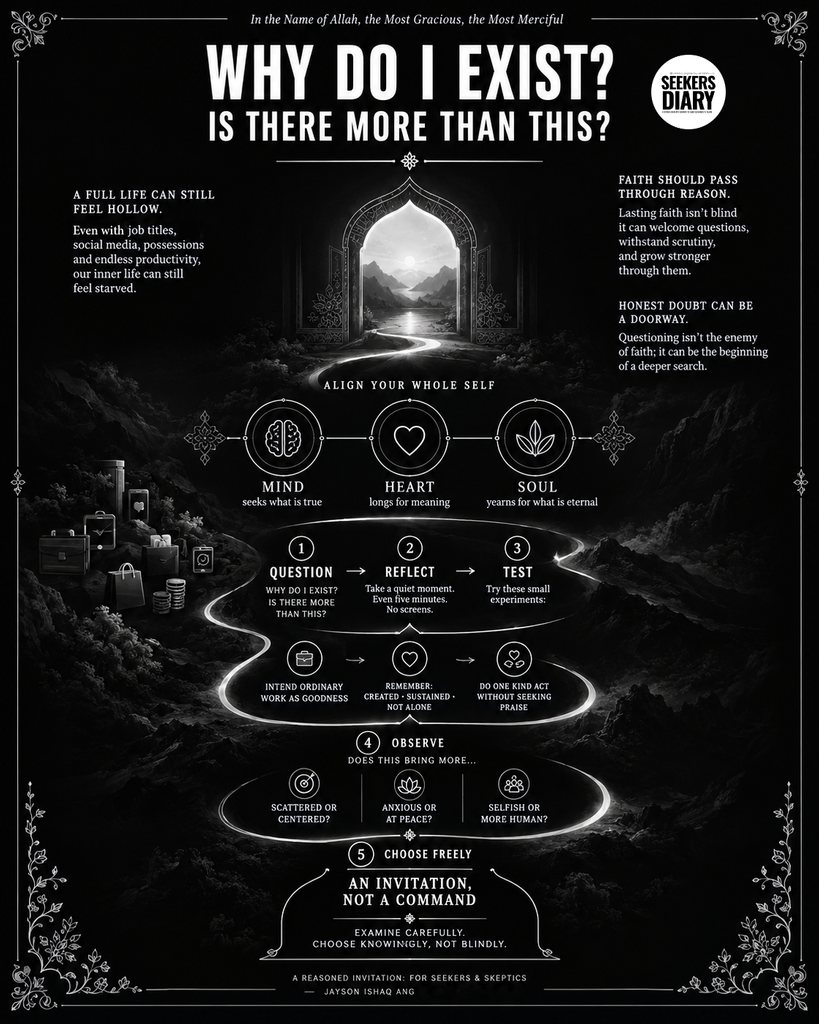
If you are skeptical, you are not a problem to be fixed. Skepticism, when honest, is not the enemy of faith but often its doorway. It means you care about the truth enough not to pretend. So instead of dismissing these pages outright; or swallowing them without thinking; try this simple method of testing:
Reflect quietly, with honesty
Set aside a small pocket of time each day, even five minutes, with no screens, no noise, no performance. Just you and your thoughts. Ask yourself questions you may usually avoid:
- If all my routines stopped, what would be left of “me”?
- Which parts of my life feel deeply real, and which feel like an act?
- What do I fear losing the most; and what does that say about what I truly worship?
Write down a few lines, not to impress anyone, but to be honest with yourself. You are not trying to be “religious” here. You are simply turning to face your own life instead of living with your back towards it.
Try small, low‑risk experiments
Do not start by trying to overhaul your entire life in one dramatic leap. Instead, test the idea of a higher purpose in small, concrete ways.
For example:
- Take one ordinary action; making coffee, commuting, working; and consciously intend it as an act of goodness and responsibility, done for something beyond your ego.
- Try a brief moment of remembrance: a whispered acknowledgment that “I am created, I am sustained, I am not alone,” and notice its effect on your inner state.
- Choose one small act of kindness done only for the sake of the One who sees you, not for recognition or praise.
Observe, not with blind hope but with curiosity:
Do these small shifts make me more scattered, or more centered?
More anxious, or more at peace? More selfish, or more human?
If the claim of a divine purpose is real, it should show its traces first in these small experiments.




DO NOT START BY TRYING TO OVERHAUL YOUR ENTIRE LIFE IN ONE DRAMATIC LEAP. INSTEAD, TEST THE IDEA OF A HIGHER PURPOSE IN SMALL, CONCRETE WAYS.

AN INVITATION
You are free to walk away at any point.
What follows is an invitation, not a command. The aim is to lay out reasons, clear language, gentle tests, and practical steps so that you can see for yourself whether the idea “My life has a divine purpose” can withstand careful examination.
You are not being asked to silence your mind in order to save your soul. You are being invited to align:
- Mind, which seeks what is true
- Heart, which longs for what is meaningful
- Soul, which yearns for what is eternal
So that any faith you eventually adopt; or reject; is done knowingly, not blindly. Thoughtfully, not reactively. And if you do discover that your existence is not an accident but a deliberate act of a Wise, Knowing Creator, then this will not be a fragile comfort. It will become a new organizing principle for your entire life.
You stand at the threshold of that enquiry now. No one can walk it for you. But you do not have to walk it unprepared; or alone.