

In the Name of Allah, the Most Gracious, the Most Merciful
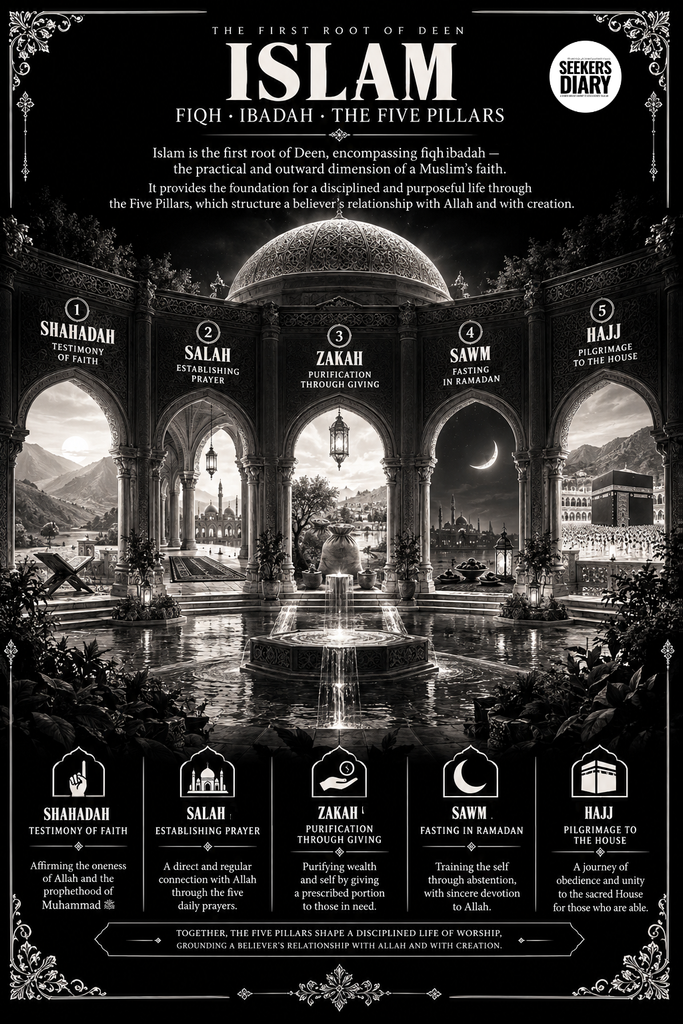
ISLAM ∙ SHARIA/FIQH (ARKANUL ISLAM) ∙ BODY
Islam is the outward, physical dimension of Deen. It is the form that submission takes in the life of a human being. If Deen is to be lived rather than merely admired, then it must appear in the movements of the body, the discipline of time, the earning and spending of wealth, the ordering of family life, and the conduct of society. This is why Islam may be described as the body of Deen: the visible structure of worship, law, discipline, and practice that governs a Muslim’s life.
Islam carries the meanings of submission, surrender, and peace. It is the practical and observable dimension of a believer’s life before Allah. It is not only what one believes, but what one does. It is not only an inward inclination, but an outward compliance. Islam gives Deen its visible structure.
Without this structure, faith has no stable form in the world. Islam is what anchors devotion in lived reality. It establishes habits of worship, moral limits, legal responsibilities, and social order. It teaches the servant how to stand, bow, give, fast, travel, trade, marry, and live. Through Islam, the servant does not merely claim surrender to Allah; he enacts that surrender.
For this reason, Islam begins with its foundational pillars, but it does not end there. The pillars are the central supports of the structure, yet the body of Deen extends into law, ethics, society, and daily life. It is an all-encompassing framework of obedience.

FIQH IBADAH ∙ 5 PILLARS OF ISLAM
The Five Pillars are the foundational acts that uphold the life of Islam. They are not decorative symbols, and they are not just labels passed down as part of being Muslim. They are living acts of submission through which the servant is trained, disciplined, and shaped. Through them, the body enters into worship, and life itself is placed under the command of Allah.
SHAHADAH ∙ DECLARATION OF FAITH
The first pillar is the Shahadah, the declaration:
“Ash-hadu an”
I bear witness that
“La ilaha illallah”
There is no fulfiller of needs except Allah
“Wa ashadu anna”
And I bear witness that
”Muhammadur Rasulullah”
Muhammad is the messenger of Allah
This testimony is the entry point into Islam, but it is far more than a statement uttered once by the tongue and left behind. The Shahadah is described not merely as speech, but as a covenant and a worldview. It must be recited with ikhlas, with sincerity, and with correct understanding. It is not enough for the tongue to move if the heart remains untouched.
The Shahadah contains both negation and affirmation:
- La ilaha – negating any creation’s independent power to grant needs
- Illallah – affirming Allah as the fulfiller of needs and therefore worthy of worship
La ilaha strips away every false claim to worship; denying any divinity or power to anything other than Allah. Illallah establishes worship for Allah alone; affirming Allah as the one true divine being and sustainer. In that brief testimony, an entire orientation to reality is set in place. The believer renounces all rivals and affirms the sole right of Allah over worship, devotion, obedience, and ultimate allegiance.
Thus, the Shahadah is not only the beginning of Islam; it is the principle that gives meaning to all that follows. Prayer, charity, fasting, and pilgrimage all stand upon this foundation. The body can only submit rightly when the heart and tongue have testified truly.
SOLAT ∙ PRAYER
If the Shahadah is the entrance into Islam, then Solat is its recurring pulse. The five daily prayers structure the believer’s day and return him again and again to his Lord. They prevent life from being absorbed entirely into the world by introducing it at fixed times with worship, humility, and remembrance.
Solat is one of the clearest expressions of Islam as the body of Deen. The body stands, bows, prostrates, and sits. The limbs submit in order. Time itself is organized around divine command. Prayer is not casual devotion, but sacred discipline. It is the pillar of daily obedience.
Beyond its outward form, Solat gathers together multiple dimensions of Deen. Outwardly, it is Islam: posture, purification, movement, recitation, and timing. Inwardly, it draws in faith and presence of heart. At its highest, it becomes an act of spiritual excellence. In that sense, prayer is not only one pillar among others; it is a meeting place where the foundations of Deen converge.
Its seriousness is further reflected in the insistence that it not be neglected. Even when one cannot pray in the normal manner, the obligation remains, whether standing, sitting, or lying down. This reveals the place of Solat in Islam: prayer is not a decorative act of piety, but an essential sign of servitude.
Solat is therefore one of the clearest manifestations of Islam as the body of Deen: the whole person is placed in obedience before Allah at fixed times throughout the day.
ZAKAT ∙ CHARITY
The third pillar is Zakat, the obligatory charity that purifies wealth and serves the community. A 2.5% annually on eligible wealth above the required threshold. But its meaning is greater than calculation alone.
Zakat is an act of worship through wealth. It reminds the believer that what he possesses is not absolutely his own, but a trust from Allah. By giving from it, he acknowledges both the Giver and the rights embedded within what he has received. Wealth is purified not by being hoarded, but by being disciplined through obedience.
Zakat must be directed properly, with care given to the eligibility of its recipients. This shows that Islam does not treat charity sentimentally. It places giving within a moral and legal order. Zakat is both devotion and justice, both purification and responsibility.
As part of the body of Deen, Zakat demonstrates that Islam extends beyond prayer into economics and society. It reforms not only the worshipper’s ritual life, but also his relationship to money, possession, and community. The body of Deen reaches into the way wealth is held, purified, and shared.
SAWM ∙ FASTING
The fourth pillar is Sawm, the fast of Ramadan. Outwardly, it is an abstention from food, drink, and intimacy from dawn until sunset. But fasting is not merely the experience of hunger. It is a discipline of restraint through which the believer is trained in obedience; that develops self-control, spiritual purification, and God-consciousness.
Sawm is one of the most striking signs that bodily practice can cultivate inner transformation. The body refrains, and through that refraining the soul is educated. Appetite is checked, impulse is disciplined, and the servant is reminded that he does not live by desire alone.
يَـٰٓأَيُّهَا ٱلَّذِينَ ءَامَنُوا۟ كُتِبَ عَلَيْكُمُ ٱلصِّيَامُ كَمَا كُتِبَ عَلَى ٱلَّذِينَ مِن قَبْلِكُمْ لَعَلَّكُمْ تَتَّقُونَ
“O believers! Fasting is prescribed for you – as it was for those before you – so perhaps you will become mindful of Allah”
Surah Al-Baqarah (2:183)
The above verse from the Qur’an: “La‘allakum tattaqun”; so that you may attain Taqwa (God-consciousness) – is a vital insight for the structure of Usul u Deen. Fasting belongs to Islam as an outward pillar, yet its stated wisdom is the cultivation of Taqwa. Here the body becomes the training ground of the heart. Outward submission opens the way to inward God-consciousness.
Thus, the body of Deen is not separate from its inward realities. Properly lived, outward obedience refines the inner life. Fasting shows how the body can become the pathway to higher spiritual states.
HAJJ ∙ PILGRIMAGE
The fifth pillar is Hajj, the pilgrimage to Makkah, required once in a lifetime for those who are physically and financially able. Hajj is presented as one of the greatest outward acts of surrender.
To perform Hajj is to leave behind the familiar world of routine, comfort, and personal control in order to answer the call of Allah. The servant travels, sacrifices, gathers with others, and enters into rites that are at once bodily, communal, historical, and spiritual. In this sense, Hajj is one of the most comprehensive physical enactments of submission.
The rituals of Hajj also embody the legacy of Sayyidina Ibrahim AS and his family, presenting it as an embodiment of the archetype of surrender. This gives Hajj a depth beyond its rituals alone. It is not simply a journey to a place, but a re-entry into a sacred pattern of obedience.
As the final pillar, Hajj gathers the themes already present in the previous pillars: testimony, worship, sacrifice, discipline, humility, and submission. It is Islam made visible in motion, journey, endurance, and devotion.

ISLAM CARRIES THE MEANINGS OF SUBMISSION, SURRENDER, AND PEACE. IT IS THE PRACTICAL AND OBSERVABLE DIMENSION OF A BELIEVER’S LIFE BEFORE ALLAH. IT IS NOT ONLY WHAT ONE BELIEVES, BUT WHAT ONE DOES.